
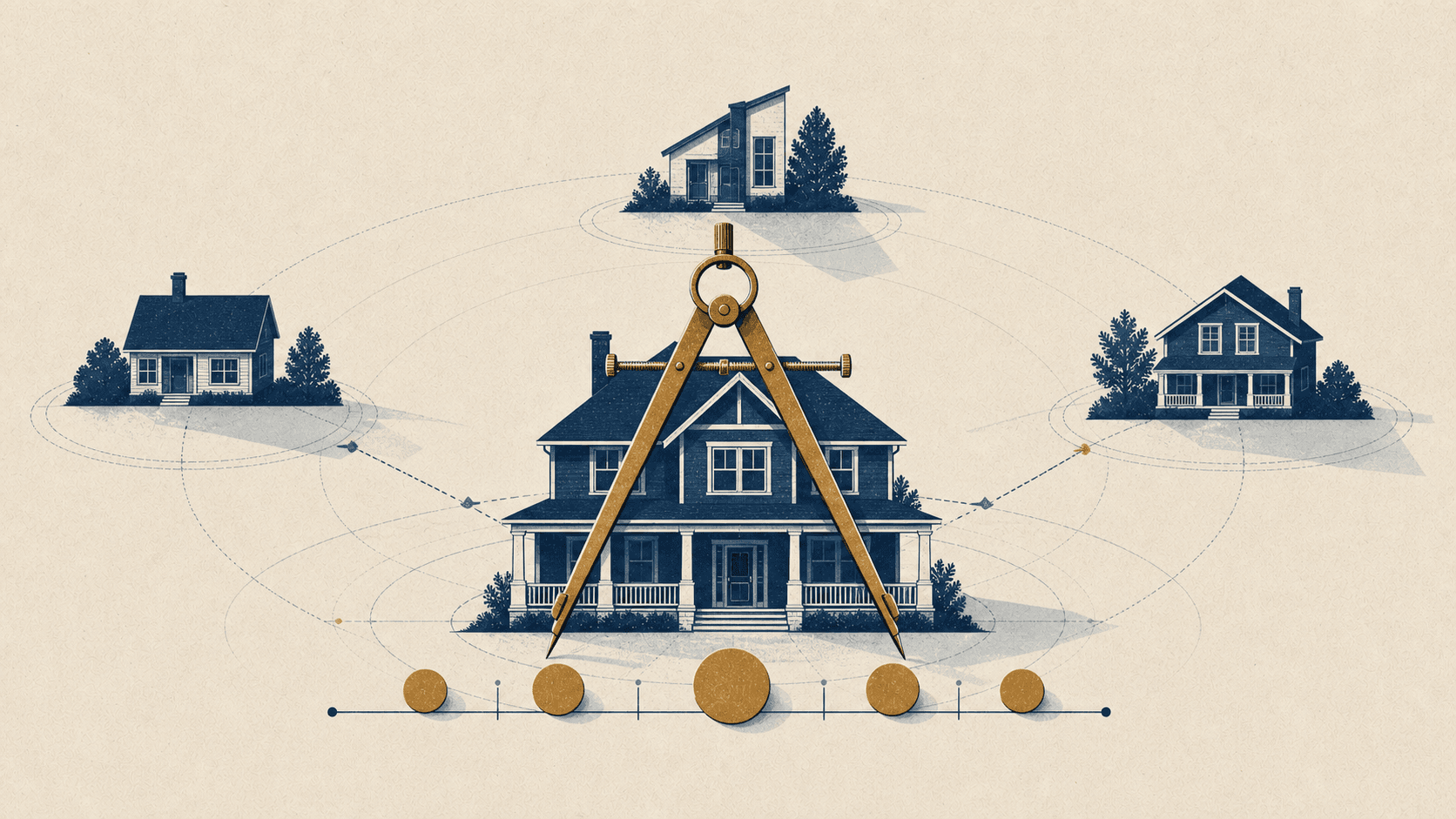
Every homeowner has looked up their address online and reacted to the number. But your home does not have one value. It has several, produced by different people for different reasons, and mixing them up costs sellers real money. The tax office's number decides your tax bill, not your price. A website's estimate is a computer's guess that has never seen your kitchen. Here is what each number means, and how the price that actually matters gets set.
The Four Numbers, and Who They Serve
When people talk about what a home is worth, they are usually mixing four different numbers:
- The online estimate — a computer model's guess from public records. Fine for a rough idea, often off by 5% or more either way.
- The tax assessment — the county's number for calculating your property tax. In many areas it lags the market by years.
- The appraisal — a licensed appraiser's opinion, ordered by the buyer's lender to protect the bank's loan.
- The market value — what a real buyer actually signs for. This is the only number that pays you.
Comparable Sales Set the Anchor
Agents and appraisers both start the same way: find homes like yours, near yours, that sold recently. These are called comps, short for comparables. A good comp is close by, similar in size and condition, and sold in the last three to six months.
Then they adjust. Your home has a finished basement and the comp does not? Add some value. The comp has a renovated kitchen and yours is original? Subtract. The skill is in choosing honest comps. A seller who cherry-picks the one overpriced sale on a nicer street is not pricing a home, they are writing a wish.
What Moves Value the Most (and Least)
Location is the famous one, and it is true at a surprisingly small scale: the same house can change value from one block to the next based on the school zone, noise, and walkability. After location, the big levers are usable space (bedrooms, bathrooms, finished square feet), condition, and the age of the expensive systems like the roof, heating, and windows.
What moves value less than owners hope: pools, high-end personal taste, and most cosmetic upgrades. A $90,000 designer kitchen rarely returns $90,000. Buyers pay for space, condition, and location. They rarely pay extra for your taste.
Why the Appraisal Can Differ from the Price
Here is the moment that surprises sellers. A buyer agrees to pay $650,000, then the lender's appraiser values the home at $620,000. The bank will only lend against the lower number, so someone has to close the $30,000 gap: the buyer brings extra cash, you lower the price, or you meet in the middle.
This happens most in fast-rising markets, where sale prices move quicker than the comps behind them. If you are selling, ask your agent to prepare a comp package for the appraiser that supports your price. Appraisers are independent, but they are human, and good recent data genuinely helps.
How to Get a Number You Can Actually Trust
Start with data, not hope. A solid automated estimate built on real sales records gives you an honest starting range in minutes. Then have an agent who works your exact area walk the home, because a computer cannot see the new roof, the awkward layout, or the train noise at 6 a.m.
The combination is the point. The model brings unbiased math from thousands of sales. The local expert brings the eyes. When both point at the same range, you can price with confidence instead of guessing.